

Introduction
The DevOps revolution fundamentally transformed software delivery by turning testing from a post-development phase into a continuous pipeline integrated with CI/CD. Driven by the relentless pursuit of faster Go-To-Market (GTM) cycles, Continuous Testing became the bedrock of modern software engineering.
Today, another acceleration wave is underway. Developers are increasingly using AI coding assistants to generate software at unprecedented speed. Code can now be drafted, refactored, and shipped faster than ever before. But this productivity surge introduces a new imbalance: if software is generated at machine speed while quality processes remain human-authored, human-reviewed, and manually maintained, teams accumulate quality debt just as quickly as they gain development velocity.
This is the inflection point for Quality Engineering. QA can no longer function only as an automated checkpoint at the end of the pipeline. It must evolve into an intelligent, adaptive system that matches the pace, scale, and variability of AI-assisted software delivery.

As DevOps matured, the industry rallied around Classic Continuous Testing, a model designed to reduce human bottlenecks through deep automation. At its core, this era popularized touch-less and headless execution. By running regression suites in headless browser environments and leveraging API-driven validation, engineering teams could execute thousands of tests rapidly and silently, without GUI overhead. Feedback loops that once took days were reduced to minutes after a commit.
At the same time, the scope of testing expanded well beyond functional validation. Performance engineering shifted left into the deployment pipeline. Instead of running large-scale load tests only before major releases, teams introduced automated performance gates that measured micro-benchmarks, resource utilization, and API latency on every build. This helped catch scalability bottlenecks and memory regressions long before staging or production.
Security also became embedded into the quality lifecycle through DevSecOps. Security validation was no longer treated as a periodic external audit. Static Application Security Testing (SAST), Dynamic Application Security Testing (DAST), software composition analysis, and dependency vulnerability scans became recurring automated checks within CI/CD pipelines. This model was transformative, but it had a ceiling. While Classic Continuous Testing achieved touch-less execution, it still depended heavily on human effort for test design, script maintenance, environment diagnosis, and false-positive analysis. The automation was deterministic and brittle by design: it only validated what it had explicitly been programmed to validate. As applications became more dynamic and release velocity continued to climb, this created a widening gap between test automation capacity and system change volume.
The arrival of Agentic AI marks a major shift from deterministic automation toward autonomous quality workflows. Traditional automation executes predefined instructions. Agentic systems, by contrast, can reason over goals, maintain context, select tools, and adapt their actions based on what they observe.
In a testing context, this means AI agents can do more than replay scripts. They can interpret user stories, inspect code diffs, navigate application flows, infer expected behaviour, generate test ideas, and investigate failures with a level of flexibility previously associated with experienced human testers.
This does not mean deterministic automation disappears. It means the Quality Engineering stack becomes layered:
| Layer | Purpose | Best fit |
|---|---|---|
| Agentic layer | Test design, exploration, self-healing, impact analysis, triage | Probabilistic, adaptive work |
| Deterministic layer | CI execution, regression validation, release gates | Stable, repeatable checks |
| Observability layer | Logs, traces, telemetry, user journeys, incidents | Real-world risk and feedback |
| Governance layer | Auditability, approval flows, policy controls, cost management | Trust, compliance, scale |
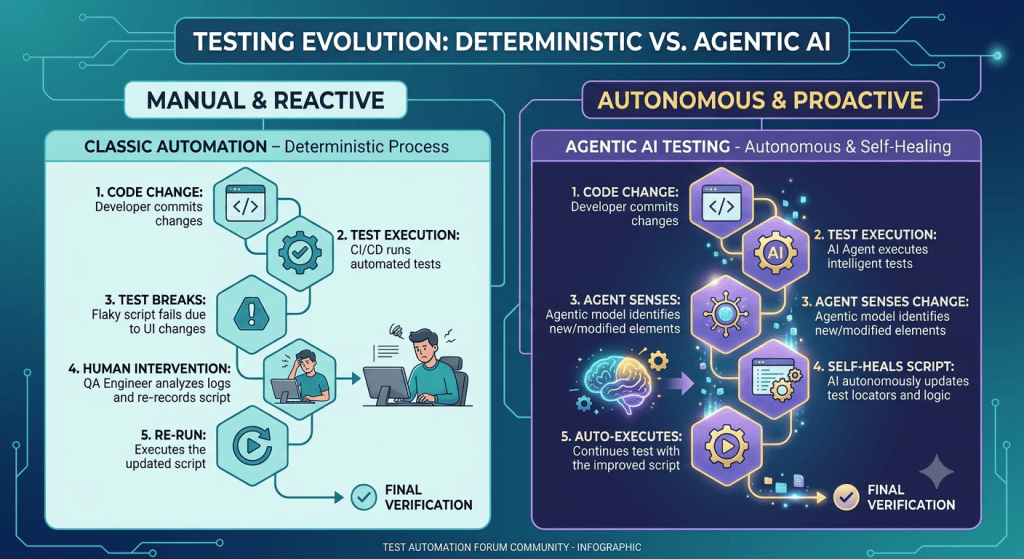
Here is a clear visual breakdown comparing the traditional, manual process of fixing broken tests to the modern, automated approach using Agentic AI. The below graphic highlights how AI-driven self-healing can significantly streamline your quality engineering workflow. This evolution reshapes the software engineering lifecycle in several important ways.
Self-healing and adaptive maintenance
One of the biggest pain points in UI and API automation has always been maintenance. A small UI label change, DOM restructuring, or API schema adjustment can break dozens of tests. Agentic systems can detect these changes, infer intent, and update locators, selectors, or test logic with minimal human intervention. That sharply reduces the maintenance burden that has historically consumed QA teams.
Autonomous test generation and failure triage
By analysing pull requests, code repositories, user stories, and historical defect patterns, AI agents can generate candidate unit, integration, API, and UI tests before a human tester even begins authoring them. When a pipeline fails, those same agents can correlate logs, recent code changes, and environment signals to identify likely root causes. In mature workflows, they can even suggest or draft fixes for developer review.
Risk-based coverage instead of coverage theatre
One of the most useful shifts enabled by AI is moving away from the vanity metric of “100% coverage.” In practice, not all code paths carry equal risk. Agentic AI can correlate code changes with production telemetry, user traffic, business-critical journeys, and historical incident data to prioritize testing where failure would create the greatest business impact.
This is especially valuable in large systems where exhaustive testing is neither feasible nor economical. The goal becomes decision-quality coverage, not maximal theoretical coverage.
Continuous exploratory testing
Traditional exploratory testing has always been valuable because it captures human curiosity and contextual judgment. Agentic AI introduces a new possibility: exploratory testing at machine scale. Agents can traverse unusual navigation paths, vary input combinations, probe edge conditions, and revisit flaky workflows continuously rather than only during a scheduled manual test cycle.
For QA leaders, this is one of the most strategic benefits: exploratory depth no longer needs to be constrained by calendar time alone.
Agentic AI is powerful, but it is also probabilistic. That means its outputs can vary across runs, and its conclusions can sometimes be wrong, incomplete, or overly confident. For that reason, one of the most important emerging design patterns in modern QA is this:
Use AI for authoring, prioritization, adaptation, and triage – but use deterministic code for release-critical execution.
In practical terms, that means an AI agent may:
- Generate a Playwright test from a user story
- Repair a broken selector after a UI change
- Suggest which regression slice to run based on risk,
- Analyze a failed build and identify likely root cause.
But the final CI gate should still rely on deterministic, version-controlled, repeatable assets such as Playwright, Cypress, Selenium, REST-assured, JUnit, contract tests, and performance scripts.
This guardrail matters for three reasons:
- Repeatability: release gates must produce consistent outcomes.
- Auditability: teams need to know what logic was executed and why.
- Trust: deterministic execution creates confidence even when AI-assisted authoring is dynamic.
The future is therefore not “AI replaces automation scripts.” It is AI that creates and manages better automation systems, while deterministic checks remain the final enforcement layer.
One of the most under-discussed but transformative shifts in agentic testing is the increasing importance of production telemetry.
Historically, testing relied mostly on requirements, acceptance criteria, and pre-production environments. But agentic systems become much more valuable when they are grounded in real-world evidence:
- User behaviour analytics
- API error trends
- Distributed tracing data
- Incident postmortems,
- Feature-flag rollout signals
- Customer support themes
- Flaky test histories
This enables a new model: quality driven by production reality. Instead of asking only, “Did the code change?” teams can ask:
- Which user journeys are most used?
- Which workflows generate the most revenue?
- Which services are already fragile?
- Where did similar changes fail before?
- Which defects escaped in the last quarter?
That context allows agents to focus testing effort where it matters most. In other words, observability is no longer just for SRE and operations; it is becoming a core input to next-generation QA.
The Quality Engineering landscape is rapidly evolving around platforms and frameworks that enable agentic workflows. At the framework level, orchestration tools such as LangChain, Microsoft AutoGen, and similar multi-agent architectures are being used to build custom QA agents for test generation, environment diagnosis, failure clustering, and workflow automation. These are especially relevant for organizations building internal quality platforms.
In the commercial space, platforms such as Mabl, Testim, and Katalon have expanded their AI capabilities to support self-healing, intelligent test maintenance, and autonomous exploratory workflows. Meanwhile, developer-centric tools such as GitHub Copilot and emerging specialized test-generation agents are influencing how unit, integration, and even end-to-end tests are authored directly from the IDE and CI pipeline.
What matters most is not the individual tool name, but the architectural direction:
- AI-assisted test authoring
- Intelligent maintenance
- Context-aware execution
- Autonomous triage
- Human-governed approvals.
Teams evaluating tools should focus less on marketing terms like “AI-powered testing” and more on practical questions:
- Does the tool produce deterministic artifacts?
- Can it explain why it took an action?
- Does it integrate with CI/CD, observability, and defect management?
- Can it operate within cost, security, and compliance constraints?
New Metrics for the Agentic Testing Era
A common mistake is to evaluate agentic QA tools using only traditional test automation metrics. In the new model, leaders need better indicators of value.
Useful metrics include:
- Test maintenance reduction: how much manual effort was removed through self-healing and automated updates?
- Defect detection lead time: how much earlier are high-risk defects being found?
- False positive rate: is the system reducing noisy failures or creating more of them?
- Flaky test suppression or isolation: is the agent improving signal quality in the pipeline?
- Risk-weighted coverage: are the most business-critical journeys receiving the most scrutiny?
- Mean time to triage: how quickly can the system explain why a build failed?
- Escaped defect reduction: are fewer serious defects reaching production?
- Cost per useful insight: are token spend and compute costs justified by measurable quality gains?
These metrics help organizations move beyond novelty and assess whether agentic AI is actually improving engineering outcomes.
Perhaps the most important shift is not technological but professional. Agentic AI does not eliminate the need for QA; it changes where QA creates value.
The modern QA engineer is increasingly becoming:
- A quality strategist who defines risk models and test priorities
- A system curator who ensures agents receive clean context and reliable data
- A governance owner who establishes approval boundaries and audit trails
- A toolsmith who connects AI workflows with CI/CD, observability, and reporting
- A critical evaluator who challenges weak AI conclusions and validates important outcomes
In this model, the most valuable QA professionals will not be those who simply write the highest number of scripts. They will be those who best understand systems, business risk, user behavior, and quality signals across the delivery lifecycle.
That is a meaningful and positive evolution for the profession. QA moves closer to engineering strategy, not farther from it.
Transitioning to agentic testing requires overcoming both cultural and operational hurdles.
Trust and the “black box” problem
Many teams are understandably cautious about relying on systems whose decision paths are not always obvious. If an agent updates a test, marks a failure as non-blocking, or recommends skipping a regression path, engineers need to know why. Explainability and audit trails are essential for adoption.
Data readiness
AI agents are only as effective as the context they receive. Poorly maintained documentation, incomplete test data, weak logging, fragmented telemetry, and inconsistent environment metadata all reduce agent effectiveness. Clean, connected data pipelines are now a quality prerequisite, not a nice-to-have.
Hallucinations and noisy output
Agentic systems can misclassify defects, infer the wrong intent, or produce plausible-sounding but incorrect failure summaries. Human-in-the-loop review remains critical, especially for release decisions and root-cause conclusions.
Cost control
Unbounded agent execution can quickly create significant token and infrastructure costs. Organizations need execution policies, caching strategies, scoped prompts, and clear economic guardrails so that AI-driven quality remains sustainable.
Skills transformation
QA teams must build new competencies in prompt design, workflow orchestration, guardrail definition, observability interpretation, and AI output evaluation. This is less about turning testers into data scientists and more about helping them become effective supervisors of autonomous quality systems.
For many organizations, the smartest path is not a big-bang transition but a staged model:
- Start with AI-assisted authoring for unit, API, and UI tests.
- Introduce self-healing cautiously in non-critical regression areas.
- Use agents for triage first, before allowing them to modify test assets automatically.
- Connect observability data so agents can prioritize by production risk.
- Keep deterministic release gates under strict version control.
- Measure outcomes using maintenance reduction, escaped defects, and triage speed.
- Expand autonomy gradually only where trust has been earned.
This phased approach helps teams realize value quickly without compromising control
The evolution from touch-less continuous testing to autonomous, Agentic AI-driven Quality Engineering is redefining modern software delivery. As software generation accelerates, quality can no longer depend on slow-moving, manually maintained automation alone. The real promise of agentic AI is not simply that it can generate more tests. It is that it can make quality systems more adaptive, risk-aware, and aligned with real production behavior. When combined with deterministic execution, observability-driven prioritization, and strong governance, agentic AI allows teams to increase development speed without surrendering confidence.
For today’s QA professionals, this shift is not a threat to relevance. It is an opportunity to operate at a higher level: from script maintenance to quality intelligence, from execution support to release assurance, and from test ownership to system-wide risk stewardship. In that sense, embracing agentic quality engineering is no longer just a competitive advantage. It is becoming a modern software delivery necessity.