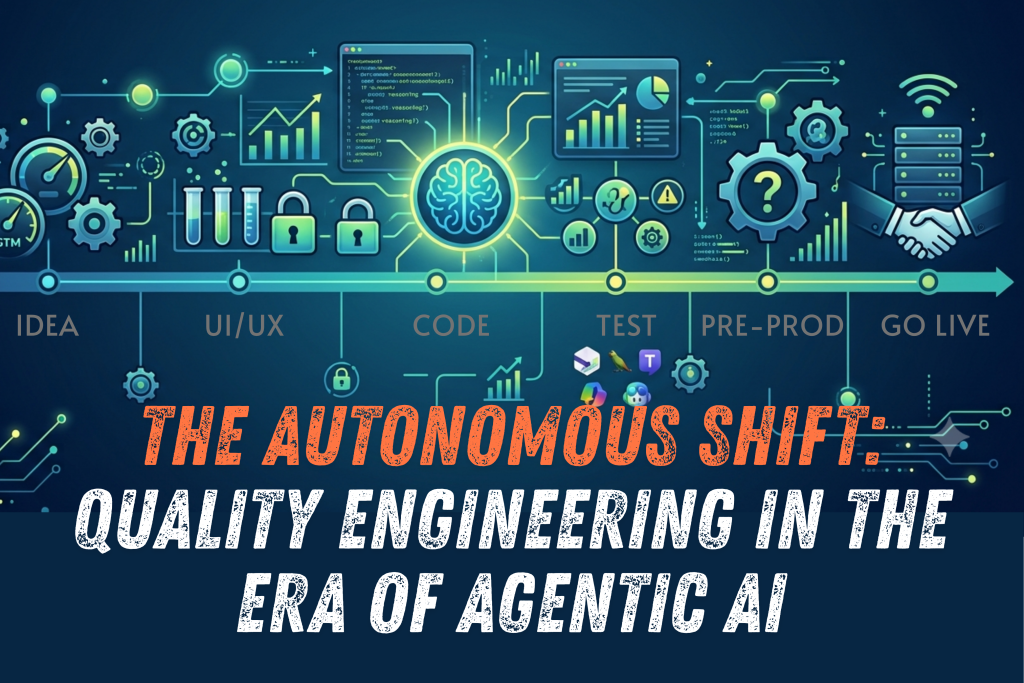
The Autonomous Shift: Quality Engineering in the Era of Agentic AI
Introduction The DevOps revolution fundamentally transformed software delivery by turning testing from a post-development phase into a continuous pipeline integrated with CI/CD. Driven by the relentless pursuit of faster Go-To-Market (GTM) cycles, Continuous Testing became the bedrock of modern software engineering. Today, another acceleration wave is underway. Developers are increasingly using AI coding assistants to generate software at unprecedented speed. Code can now be drafted, refactored, and shipped faster than ever before. But this productivity surge introduces a new imbalance: if software is generated at machine speed while quality processes remain human-authored, human-reviewed, and manually maintained, teams accumulate quality debt just as quickly as they gain development velocity. This is the inflection point for Quality Engineering. QA can no longer function only as an automated checkpoint at the end of the pipeline. It must evolve into an intelligent, adaptive system that matches the pace, scale, and variability of AI-assisted software delivery. The Era of Classic Continuous Testing As DevOps matured, the industry rallied around Classic Continuous Testing, a model designed to reduce human bottlenecks through deep automation. At its core, this era popularized touch-less and headless execution. By running regression suites in headless browser environments and leveraging API-driven validation, engineering teams could execute thousands of tests rapidly and silently, without GUI overhead. Feedback loops that once took days were reduced to minutes after a commit. At the same time, the scope of testing expanded well beyond functional validation. Performance engineering shifted left into the deployment pipeline. Instead of running large-scale load tests only before major releases, teams introduced automated performance gates that measured micro-benchmarks, resource utilization, and API latency on every build. This helped catch scalability bottlenecks and memory regressions long before staging or production. Security also became embedded into the quality lifecycle through DevSecOps. Security validation was no longer treated as a periodic external audit. Static Application Security Testing (SAST), Dynamic Application Security Testing (DAST), software composition analysis, and dependency vulnerability scans became recurring automated checks within CI/CD pipelines. This model was transformative, but it had a ceiling. While Classic Continuous Testing achieved touch-less execution, it still depended heavily on human effort for test design, script maintenance, environment diagnosis, and false-positive analysis. The automation was deterministic and brittle by design: it only validated what it had explicitly been programmed to validate. As applications became more dynamic and release velocity continued to climb, this created a widening gap between test automation capacity and system change volume. From Deterministic Automation to Agentic Quality Engineering The arrival of Agentic AI marks a major shift from deterministic automation toward autonomous quality workflows. Traditional automation executes predefined instructions. Agentic systems, by contrast, can reason over goals, maintain context, select tools, and adapt their actions based on what they observe. In a testing context, this means AI agents can do more than replay scripts. They can interpret user stories, inspect code diffs, navigate application flows, infer expected behaviour, generate test ideas, and investigate failures with a level of flexibility previously associated with experienced human testers. This does not mean deterministic automation disappears. It means the Quality Engineering stack becomes layered: Layer Purpose Best fit Agentic layer Test design, exploration, self-healing, impact analysis, triage Probabilistic, adaptive work Deterministic layer CI execution, regression validation, release gates Stable, repeatable checks Observability layer Logs, traces, telemetry, user journeys, incidents Real-world risk and feedback Governance layer Auditability, approval flows, policy controls, cost management Trust, compliance, scale What Agentic AI Changes in Practice Here is a clear visual breakdown comparing the traditional, manual process of fixing broken tests to the modern, automated approach using Agentic AI. The below graphic highlights how AI-driven self-healing can significantly streamline your quality engineering workflow. This evolution reshapes the software engineering lifecycle in several important ways. Self-healing and adaptive maintenance One of the biggest pain points in UI and API automation has always been maintenance. A small UI label change, DOM restructuring, or API schema adjustment can break dozens of tests. Agentic systems can detect these changes, infer intent, and update locators, selectors, or test logic with minimal human intervention. That sharply reduces the maintenance burden that has historically consumed QA teams. Autonomous test generation and failure triage By analysing pull requests, code repositories, user stories, and historical defect patterns, AI agents can generate candidate unit, integration, API, and UI tests before a human tester even begins authoring them. When a pipeline fails, those same agents can correlate logs, recent code changes, and environment signals to identify likely root causes. In mature workflows, they can even suggest or draft fixes for developer review. Risk-based coverage instead of coverage theatre One of the most useful shifts enabled by AI is moving away from the vanity metric of “100% coverage.” In practice, not all code paths carry equal risk. Agentic AI can correlate code changes with production telemetry, user traffic, business-critical journeys, and historical incident data to prioritize testing where failure would create the greatest business impact. This is especially valuable in large systems where exhaustive testing is neither feasible nor economical. The goal becomes decision-quality coverage, not maximal theoretical coverage. Continuous exploratory testing Traditional exploratory testing has always been valuable because it captures human curiosity and contextual judgment. Agentic AI introduces a new possibility: exploratory testing at machine scale. Agents can traverse unusual navigation paths, vary input combinations, probe edge conditions, and revisit flaky workflows continuously rather than only during a scheduled manual test cycle. For QA leaders, this is one of the most strategic benefits: exploratory depth no longer needs to be constrained by calendar time alone. The Deterministic Guardrail Agentic AI is powerful, but it is also probabilistic. That means its outputs can vary across runs, and its conclusions can sometimes be wrong, incomplete, or overly confident. For that reason, one of the most important emerging design patterns in modern QA is this: Use AI for authoring, prioritization, adaptation, and triage – but use deterministic code for release-critical execution. In practical terms, that means an AI agent may: Generate a Playwright test from a user story Repair a broken selector after a UI change Suggest which regression slice to run based on risk, Analyze