Test Automation Forum

Welcome to TAF - Your favourite Knowledge Base for the latest Quality Engineering updates.

Test
Automation
Forum

(Focused on Functional, Performance, Security and AI/ML Testing)

Brought to you by MOHS10 Technologies

Amit Kumar Prasad

The Test Automation Pyramid in 2025: A Modern Perspective

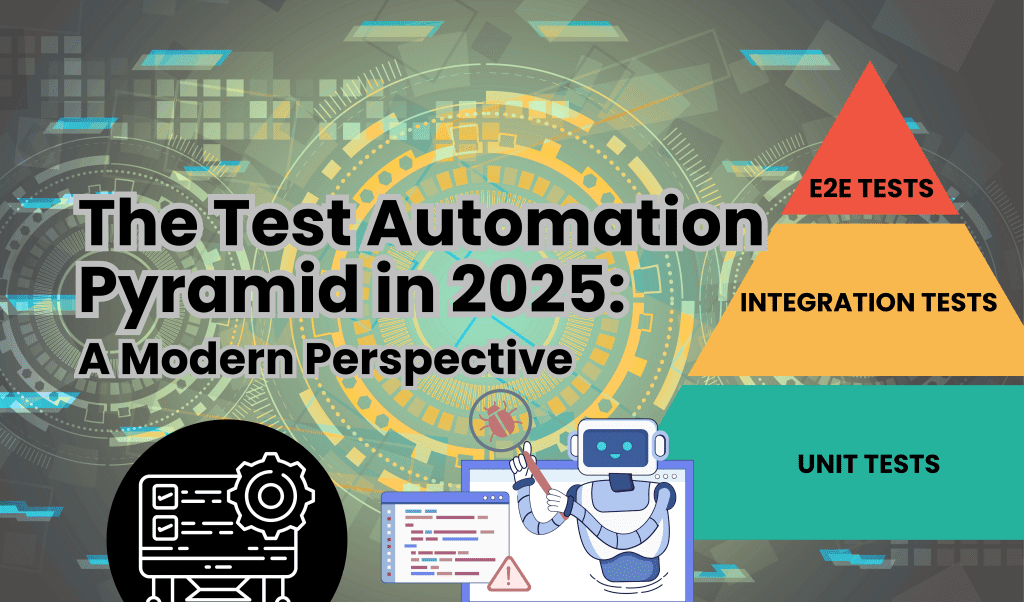
Introduction The test automation pyramid has long been a cornerstone for structuring software quality assurance. Mike Cohn’s original model advocated a broad base of unit tests, a middle layer of integration/service/API tests, and a slim top of end-to-end UI tests. Agile and DevOps teams have relied on this strategy to balance speed, coverage, and reliability. Fast forward to 2025: the pyramid continues to evolve, shaped by rising microservices adoption, cloud-native architectures, and AI-driven automation-requiring teams to rethink and modernize their approach to scalable quality.   Revisiting the Foundation: Unit Tests The broad foundation of the pyramid-unit tests-remains as vital as ever. These tests validate small, isolated units of code and run in milliseconds, contributing to fast feedback during CI/CD pipelines. In modern architectures, unit tests anchor the pyramid’s efficiency. Well-designed unit tests quickly pinpoint problems, facilitate refactoring, and allow continuous deployment with confidence. By expanding coverage at the base, teams prevent defects from cascading into higher layers, slashing bug-fix costs and timelines by 30-50%. Modern static analysis and AI-powered test generation-such as Mohs10 Technologies’ GenAI-driven QE platform-further fortify unit test strategies, proactively catching issues at code inception. Mohs10 automates unit test creation for microservices, leveraging mutation testing to achieve 95% code coverage in under 10 seconds, enabling teams to refactor with zero downtime. Test data factories, mocking libraries, and mutation testing tools are now standard additions, reinforcing the pyramid’s rock-solid bottom. The Middle Layer: Integration and Service/API Testing  In monolithic systems, integration tests often validated a handful of system components. Microservices and distributed cloud apps have shifted this landscape dramatically. In 2025, service/API tests validate interactions between dozens (sometimes hundreds) of microservices, databases, and third-party APIs, making this layer critical to scalable quality. Modern integration testing leverages contract-driven approaches, service virtualization, and real-time message simulations. API contract testing tools (like Pact and Postman), container orchestration, and chaos engineering tests help teams model real-world interactions and fault tolerance. This middle layer balances speed and coverage, efficiently surfacing business logic issues before touching the UI. The biggest challenge? Maintaining reliable, fast-running tests amid asynchronous service calls and dynamic scaling. Leading teams overcome this with parallel test execution, cloud-native environments, and synthetic data management-strategies that preserve pipeline velocity while maximizing coverage. Mohs10 Technologies addresses this head-on with contract testing via Pact integrated into Kubernetes-orchestrated environments, simulating real-time healthcare API calls (e.g., EHR integrations) to guarantee 99.9% uptime and zero-downtime deployments. The Top Layer: Targeted End-to-End UI Testing  End-to-end tests simulate real user journeys, validating that the entire system behaves correctly across integrated workflows. However, they are the slowest, most brittle, and most expensive to maintain. In 2025, top-performing teams limit E2E tests to critical business scenarios: checkout flows, login, registration, and vital integrations. Modern best practices include: Selective E2E coverage: Only the most essential user journeys. Stable environments: Cloud-based setups mirroring real production (but controlled). AI-driven test healing: Auto-fix locators and remove flakiness. Visual testing: Pixel-precise checks to catch UI regressions. A well-balanced pyramid avoids over-investment in E2E, keeping the top thin and sustainable. How the Pyramid Adapts to Modern Architectures Microservices, containers, and cloud-native systems have stretched the classic pyramid model: Service Meshes: Require mesh-aware testing for routing, security, and latency. Event-Driven Architectures: Demand asynchronous test strategies. Chaos Engineering: Injects failures to ensure graceful degradation. Infrastructure as Code: Test automation for cloud resources, policies, and configurations. The modern pyramid is more flexible: sometimes the “skyscraper” model or diamond-shaped structures surface, accommodating complex service-to-service tests. Practical Implementation Tips Continuous Testing: Automate everything-unit, API, and UI tests-in CI/CD. Test Data Management: Invest in synthetic data generation and automation for consistency. Shift-Left QA: Move more tests early into the pipeline, integrating with source control and build triggers. Test Observability: Use dashboards, logs, and analysis to pinpoint failures fast. Parallel Execution: Speed up feedback by running tests concurrently. DevSecOps Integration: Embed security tests at every layer for compliance. Partner with AI-QE Leaders: Team up with Mohs10 Technologies for custom pyramid audits and GenAI self-healing bots-gain exclusive insights and Amazon rewards. Teams succeeding with the pyramid leverage low-code platforms, self-healing scripts, and containerized test environments-empowering both technical and non-technical contributors.Common Challenges (and How Modern Teams Overcome Them)  Challenge Solution Too many E2E/UI tests Shift coverage to unit/API layers, reduce brittle UI checks Slow feedback and long pipelines Parallelize, optimize, and remove redundant tests Flaky tests and inconsistent results Use AI-driven healing and better test data Limited microservice coverage Adopt contract tests, service virtualization, chaos testing Poor test documentation Use dashboards and test reporting with actionable insights Data management bottlenecks Automate synthetic test data, use fixtures and factories The Test Automation Pyramid in Agile and DevOps Agile and DevOps environments benefit most from the pyramid’s strategy-continuous monitoring, rapid feedback, and scalable automation. Designs that emphasize a thick base (unit & API/service tests) deliver stable releases and keep technical debt low. Agile squads refine their test suites iteratively, applying automation platforms and reporting tools that foster transparency and accountability.  The Pyramid’s Future: 2025 and Beyond Emerging trends continue to reshape the landscape: AI-Driven Test Case Generation: Using machine learning to design and update test flows. Autonomous QA Bots: Self-healing and self-optimizing test suites Wireless & IoT Testing Integration: Expanding layers for device, protocol, and edge validation. Security-First QA: DevSecOps embeds security checks in every layer for compliance. Cloud Policy & Infrastructure Testing: Automated infrastructure as code (IaC) checks as part of the pyramid’s lower tiers. The automation pyramid isn’t a static artifact-it’s a living strategy refined by each new technology wave, ensuring quality, speed, and security are never compromised. Conclusion The test automation pyramid in 2025 remains the gold standard for scalable, reliable quality-provided it evolves with microservices, cloud-native systems, and AI-driven testing. Prioritize a rock-solid base of unit tests, fortify the middle with contract-driven API and integration testing, and keep end-to-end UI tests razor-thin and self-healing. Embrace DevSecOps, chaos engineering, and autonomous QA bots to stay ahead of complexity. Start auditing your pyramid today: shift coverage left, parallelize execution, and integrate synthetic data with AI test healing.

image

Security Testing: A Shield Against Modern Cyber Threats

Introduction: Security testing is an important aspect of software testing focused on identifying and addressing security vulnerabilities in a software application. It aims to ensure that the software is secure from malicious attacks, unauthorized access, and data breaches. Security testing involves verifying the software’s compliance with security standards, evaluating the security features and mechanisms, and conducting penetration tests to identify weaknesses and vulnerabilities that might be exploited by malicious actors. The goal of security testing is to identify security risks and offer recommendations for remediation to improve the overall security of the software application. Testers simulate attacks to check existing security mechanisms and look for new vulnerabilities. Security testing has evolved significantly over the years: In the early days of computing, security was a lesser concern due to isolated systems. The 1980s saw the rise of hacking culture, emphasizing the need for security. The growth of the internet in the 1990s heightened security concerns. The 2000s brought malware and web application vulnerabilities to the forefront. High-profile data breaches in the 2010s underscored the importance of security testing. Today, with sophisticated threats, security testing relies on automation, AI, and machine learning. What are the main type of security testing? Vulnerability Scanning: Vulnerability scanning involves automated tools to identify security vulnerabilities in a software application or network. The aim of vulnerability scanning is to identify and report potential security threats and recommend remediation measures. It provides a security baseline and focuses on known risks Penetration testing: Penetration testing is a subset of ethical hacking that involves simulating real-world attacks to locate vulnerabilities in a software application. The goal of penetration testing is to identify potential security threats and how to remediate them. Penetration testing can be performed either manually or with automated tools and may include techniques such as social engineering, network scanning, and application-layer testing. Application security testing: Application security testing (AST) is the process of evaluating the security of a software application and identifying potential vulnerabilities. It involves a combination of automated and manual testing techniques, such as code analysis, penetration testing, and security scanning. The goal of application security tests is to detect and mitigate security risks to the software application. AST is important for identifying both external and internal threats. Web application security testing: Web application security testing is a specialized type of AST that focuses on identifying vulnerabilities in web-based applications. This type of testing typically involves a combination of manual and automated testing methods, such as SQL injection testing, cross-site scripting (XSS) testing, and authentication testing. API Testing: API security testing involves evaluating the security of an application’s APIs and the systems that they interact with. This type of testing typically involves sending various types of malicious requests to the APIs and analysing their responses to identify potential vulnerabilities. The goal of API security testing is to ensure that APIs are secure from attacks and that sensitive data is protected. This is important because APIs are vulnerable to specific threats, including denial-of-service (DoS) attacks, API injection, and man-in-the middle (MitM) attacks, where an attacker intercepts the API communications to steal sensitive information. Security auditing: Security auditing is the process of evaluating the security of a software application or network to identify potential vulnerabilities and to ensure that it is in compliance with security standards and best practices. This type of testing typically includes manual methods, such as code review, vulnerability scanning, and penetration tests. Risk Assessments: A risk assessment involves identifying potential security threats and assessing the possible impact of these threats on a software application or network. The goal of a risk assessment is to prioritize the security risks based on their predicted impact and to develop a plan to mitigate these risks. Security posture assessments: Security posture assessments involve evaluating an organization’s overall security posture, including its policies, procedures, technologies, and processes. Regular assessments can help to identify potential security risks and recommend ways of improving the overall security strategy and implementation of the organization. Common vulnerabilities Common security vulnerabilities are weaknesses or flaws in the design, implementation, or configuration of a system, application, or network that can be exploited by attackers to compromise the security of the system. These vulnerabilities can lead to data breaches, unauthorized access, data manipulation, and other security incidents. Here are some common security vulnerabilities  SQL Injection (SQLi)  Cross-Site Scripting (XSS)  Cross-Site Request Forgery (CSRF)  Insecure Authentication and Authorization  Broken Authentication and Session Management  Injection Attacks (e.g., Command Injection)  Server-Side Request Forgery (SSRF)  Insecure Direct Object References (IDOR) Tools used for security testing  Nessus  N Map  Zed Attack Proxy (ZAP)  Burp Suite  Qualys Guard  Sonar Qube  Check Mark  Metasploit…. Etc Challenges  False Positives: Security testing tools may generate false positives, indicating vulnerabilities that don’t exist, leading to wasted time and resources.  False Negatives: Conversely, false negatives occur when security tools miss actual vulnerabilities, leaving systems exposed.  Evolving Threat Landscape: The rapidly changing threat landscape means that security testing needs to keep pace with emerging attack techniques and vulnerabilities.  Resource-Intensive: Security testing can be resource-intensive, requiring specialized tools, skilled personnel, and time, which can be costly.  Complexity: As systems and applications become more complex, it can be challenging to comprehensively assess and test every component and interaction.  Integration Issues: Integrating security testing into the development process can be challenging, especially if it wasn’t considered from the beginning.  Limitations  Testing Scope: Security testing often focuses on specific aspects, leaving other potential vulnerabilities unexplored.  Human Error: Security testing, like any other human activity, is susceptible to human error, potentially overlooking vulnerabilities.  Security by Obscurity: Relying solely on security testing can lead to a false sense of security, as it doesn’t account for vulnerabilities that aren’t well-known.  Environmental Differences: Test environments may not perfectly mirror production environments, leading to discrepancies in results.  Compliance vs. Security: Focusing solely on compliance testing may not address all security concerns; it may only meet minimum requirements.  Vulnerability Disclosure: Security testing may uncover vulnerabilities that, if not disclosed responsibly, can be exploited by malicious actors. Best practices

Submit your article summary today!

[wpforms id="2606"]
Contact Form

Thank you for your interest in authoring an article for this forum. We are very excited about it!

Please provide a high level summary of your topic as in the form below. We will review and reach out to you shortly to take it from here. Once your article is accepted for the forum, we will be glad to offer you some amazing Amazon gift coupons.

You can also reach out to us at info@testautomationforum.com